This is something I wrote a few weeks ago. Let me say at the outset, that the last week or so I feel the black clouds have lifted significantly.
I've been debating writing this post. I want as much as possible to focus on the things I've done, seen, experienced living in Iraq - not all of those are positive and I will write some of the challenges and difficulties; but I wasn't sure whether to write about my own mental well-being. Then I wrote it, which was kind of cathartic, and debated whether to publish it. I don't want people to be worried about me. I don't want to give power to emotions that I know are not true. I'm a bit embarrassed by what I've owned up to. But then I decided actually it is important to be real, without giving those emotions a foothold - a tough line to walk. So here goes......
Burn out is a term we hear a lot in our work. It's the thing that we're all supposed to take steps to avoid - the usual stuff - exercise, sleeping well, eating well, having a good support network etc etc. It's why we get enforced R&R breaks regularly that are paid for by our employers. Humanitarian work is known to be one of the most stressful jobs in the world. I went to a stress-management (anti-burn out) day a couple of years ago run by the Headington Institute and they talked about how to un-do the damage that is done to your brain through stress. An example would be that the average person in a stressful job in the UK would need to exercise for 60 minutes 3 times a week. For us, to un-do the damage, we need to do 60 minutes of exercise every single day. There were many other helpful lessons in that day around habits to nurture in order to maintain resilience. But I found it shocking to see in statistics just how stressful our jobs are measured to be - when you get on with it every day and just keep going you can easily lose sight of that.
There have been times over the last years where I have felt run down, and have acknowledged that I need to make some small changes to increase my resilience. And I've done that and bounced back. I stay in close touch with my family. I have tried to maintain close friendships with a small group of people who know me well. I have made a conscious effort to engage my creative side regularly through cooking, drawing and knitting. I've gone on days out in Iraq to make sure I see the beauty of this country. I make sure I get to the field regularly so that I don't just sit at a desk all the time.
Fast forward to the last few weeks. We have had significant changes at work over the last 4 months, and adapting to change is always exhausting. I also have the accumulated tiredness and stress of the last 3+ years. I have known for a while my leaving date, but it has become clear that there will not be someone here to take my place before I finish. I started to think about whether I should offer to extend my contract just a little more - literally just a few weeks.
And then I realised that I have cried every single day for about a month. Despite having friends around me I have suddenly felt incredibly lonely and isolated. I have not been sleeping well at all. I have out of nowhere developed heartburn, and am waking up in the night with a mouthful of stomach acid (sorry if that's TMI!). I'm not as effective at work as I was. I struggle to think of the words for things and instead start describing them - "you know that thing that you use to eat cereal with" (a spoon). I regularly question whether I am any good at my job. I get sick easily. Basically I think I'm heading towards burn out. It's quite a scary place to be in some ways. I continue to function and do my job reasonably well, but on the inside I'm sad and not happy with myself. I regularly think I don't recognise myself in terms of my thoughts, my level of sadness and emotion. This has kind of crept up on me to be honest. For a while now I've said to friends here that I need to leave and take a break from work in order to re-set myself. But this level of sadness and rollercoaster emotions has built up rapidly in the last couple of months. It has taken a lot of effort to remind myself of the truth that I am not alone and that I am not rubbish at my job.
So I think it's absolutely right that I leave Iraq in a week's time. I desperately need time to rest and re-charge. I need time when I have no responsibilities. It's hard to admit that really. When you love your job like I do, it's hard to face the fact that if you don't stop working you will end up doing damage to yourself and to those you work with in turn. But I know this is the right decision and I am looking forward to my 'unemployment time'. I'm so excited for time with family, special memories to be made with my gorgeous niblings, time to catch up properly with friends, and time to just lie on the sofa reading.
Friday, 2 March 2018

Sunday, 25 February 2018
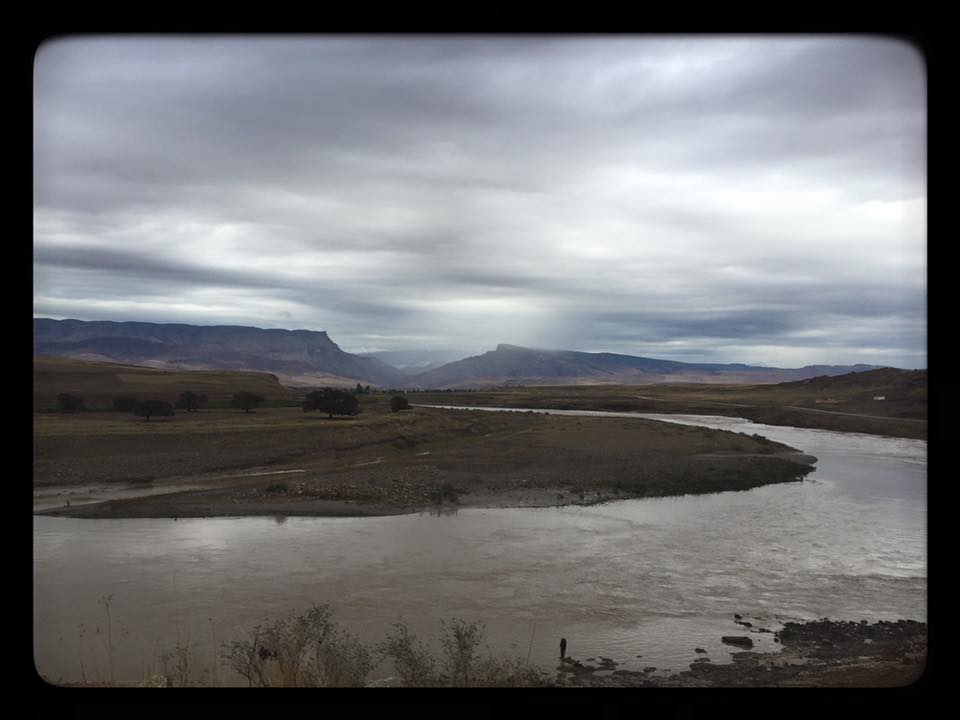
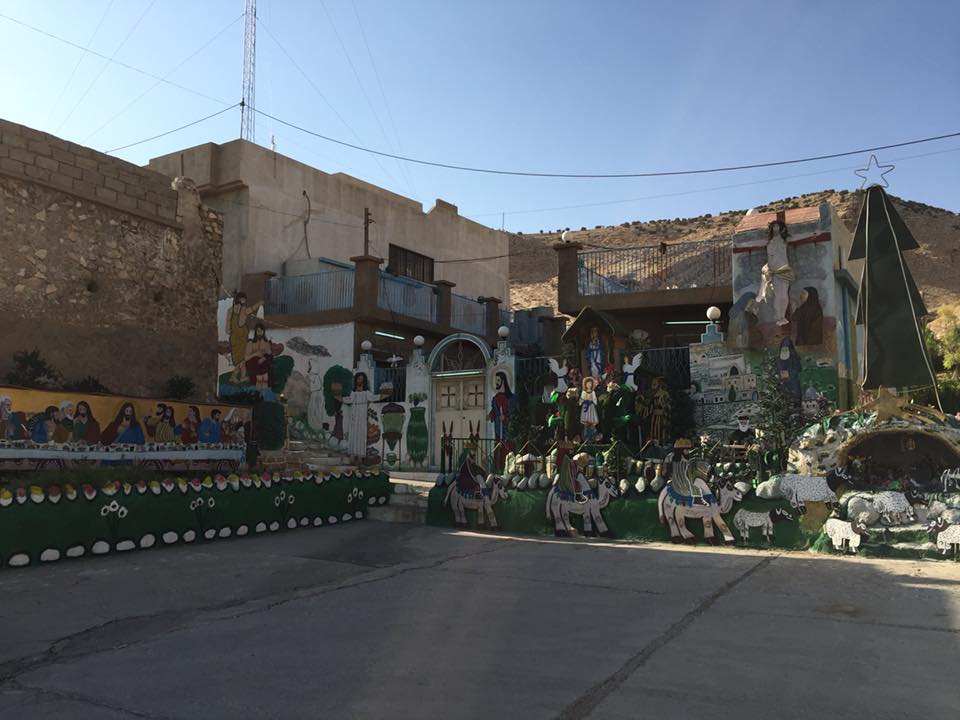
I bet you didn't think Iraq looked like this......
Some of my favourite photos that will make you question the media's portrayal of this beautiful country:






Sunday, 11 February 2018
Twenty Top Team Moments
For this blog I thought I'd put down some of my top team moments from the last years in Iraq. For those that I've worked with - it has been a joy with a lot of laughs along the way! There have been so many highs that it's been hard to choose, but here are a few:
- Karoake fun together in our basement in Dohuk. Somewhere I have a video of the whole team, national and expat, singing power ballads together.
- Tofurkey. That very special delivery for Claudia to eat for her birthday/Thanksgiving.
- Sundowners on Zawa Mountain. Having a picnic takeaway on the top of a mountain, drinking beers as we watched the sun go down over the city, and listening to the call to prayer rise up. And then nearly wetting ourselves with laughter as we shared various crazy stories.
- An impromptu lunch picnic in the park to cheer everyone up when they haven't been able to go to their field sites all week and are sick of the four walls of the office.
- Team first aid drills in Dohuk - that time when Andy pretended to have collapsed for me, and everyone just walked past him and ignored him on the floor of the office. Until they decided to kick him back to life.
- The 2017 end of year party for the Erbil team - what a great night of games and dancing. Introducing the team to 'bring me a...' was an absolute highlight.
- Making Pimms lollies when it was 50 degrees - best idea ever!
- Friday Fry Ups in Dohuk with the first team - all bustling around the kitchen, and then sitting in the sun with our food, easing in to the weekend.
- Monopoly Deal. Say no more.
- Team bowling and seeing Khair's very unique style :-)
- Going to weddings together. There's been a few, and they've all been a lot of fun.
- Road trips and field visits galore. I should have logged how many hours I have spent in the car - it's insane. But it's a good way to get to know your team.
- Various bonfire nights and pancake nights - sharing the British love.
- Cooking up Bertie the Boar.
- Christmas Day this year - my first Christmas away from home but we had a fantastic team day.
- Monthly birthday celebrations - something I've done in both Tearfund and DRC.
- Team banter, be that face to face or over skype, banter has a large part to play in why I'm still smiling 3.5 years later.
- The One Year Anniversary party at the Qayyarah Airstrip Camp - celebrating with the staff who have worked so hard to make the place a home for the residents was brilliant.
- Our first overnight in Mosul. Only 3 of us, but what a moment to get to stay there for the first time!
- Lunch time pretty much every day. A few months ago I made a deal with the staff that DRC would pay for a cook's salary if they were willing to purchase a cooked lunch. So we all get a delicious and cheap lunch every day, which we eat together in our staff room.
P.S. Just for Mariam, I will mention 'Family Time'. I know she'd want me to :-)
Wednesday, 7 February 2018
Cultural Characteristics
With only about a month left living in Iraq, I thought I would re-ignite the blogs with a few around my favourite things and memories about this wonderful country, and some of the challenges I have faced here. First up - some of my favourite cultural characteristics:
- Iraqi and Syrian people, of all ethnicities have a cracking sense of humour. Which is useful when you live in a country that has not been truly peaceful for many, many years. They also understand my British teasing and sarcasm which certainly helps in my quest to be a well-liked boss :-)
- This is quite probably the most generous nation I have ever been to. I only have to say 'oh I like your coat/scarf/earrings/sandwich' and it is instantly offered to me. If I have run out of cash, someone will instantly buy my lunch. If I forget my wallet and I want some fruit, I can pay the fruit stall man tomorrow or the next day or whenever.
- This culture is welcoming to the foreigner. Whether you are from another city, or another country you are welcomed. Whether you have been displaced by conflict or you are here to work like me, you are accepted and made to feel at home.
- Old people are treated with respect and honour. They are cared for and they are included.
- Meals. You don't eat alone in this country. You eat with people, and it's an event.

- Middle Eastern music has grown on me hugely in my time here. And particularly the local music. I love that western tastes have not taken over and people are still so proud of this aspect of their heritage.
- Many residential areas are built around communal gardens - outside my house is a little park which the houses surround on all sides. In the evenings the kids play football, and ladies walk around the paths. There is a gardener who tends to the flowers and keeps things nice. In my old house in Dohuk we had a similar set up, although there the garden was split in to plots. But I like this way of using outside space - people don't tend to have their own gardens - just a small patio area, but then they share these small green spaces together.
- Iraqi people are excellent at grieving together and celebrating together. There is a sense of putting your own awkwardness aside to enter in to other people's grief or joy, and this leads to genuine community. (I've written a whole blog on this one).
- Tea drinking is a huge part of life here. It doesn't really matter the time of day, if you sit down with people you will be offered chai. A small glass of strong, slightly spiced, sweet black tea. It's delicious and somehow it helps conversation to flow.
- Dominoes are a serious game here. It's where I have learned to play properly. It's really a man's game, and every cafe will have men playing dominoes and draughts, whilst smoking shisha and drinking tea.


Saturday, 13 January 2018
Water
This week I finally had the opportunity to visit a project we have recently completed - I have been trying to visit for some time, but other priorities always got in the way, so I was thrilled to get there this week.
Some months ago, as Mosul was being re-taken neighbourhood, by neighbourhood, the Directorate of Water (DoW) reached out to a number of agencies requesting assistance to repair water infrastructure throughout the district of Mosul. At DRC, we have built up quite an expertise in this particular area, and I have blogged before about other water infrastructure projects we have worked on. So when the DoW approached us we agreed to work on what is commonly known as the 'New Right Bank' (NRB) water project. This is a huge water treatment and pumping station on the outskirts of west Mosul, and is the second largest station in the country. During the time of ISIS, and their defeat, it was badly damaged and was left in complete disrepair, not functioning at all. This meant that residents in west Mosul and surrounding areas were not receiving any drinkable water from their taps. In the immediate aftermath of the fighting, residents in Mosul were heavily reliant on water trucks bringing drinkable water to their locations.
One of my teams is a Water, Sanitation and Hygiene (WASH) team - think lots of loveable geeks and engineers :-) This team is then split in two - one side works on the camp, ensuring residents have access to clean water, sanitation and hygiene items and knowledge all the time. The other side works on water infrastructure projects - they are experts in the engineering and mechanics of things like pumping stations. It is this team that took on the NRB project on behalf of the government. After weeks of cleaning, repairing, installing new parts, training new government staff; we were able to hand back to them a functioning water treatment plant that pumps out 12,000,000 litres of clean drinking water an hour, up to 22 hours a day, 365 days a year. This means that residents who are returning to re-build their homes in west Mosul and the surrounding areas can turn on their taps and drink the water without fear of disease. In a country where cholera is present, this is huge.
Before I went to see the project, I knew the scale from the meetings I'd been in and the reports from the team. But seeing it and having a tour from the government manager of the station was a whole different experience. It is a feat of engineering in an area where nothing has been left untouched by war. The buildings still have blown out windows, bullet marks, rocket holes. There still aren't enough staff as it takes so long to get security approvals for staff to work in a government facility due to the recent conflict, the whole perimeter still has to be guarded by the army to ensure it's not looted or worse, and there are still some further repairs needed. But to know that our investment, coupled with the expertise of our staff, has led to so many people having access to safe drinking water is phenomenal.
NB: there are some photos below. I have captioned them, but I may not have the technical terms perfect for everything as I am not an engineer :-) But the basic process goes - intake from the river, settlement tanks to take out large particles, fast mixer with first chlorination, filtration through various grades of sand, second chlorination, pumping out to the network. The water is then tested for chlorine levels several times a day using a rapid test and once a week using a full lab test. I don't have a photo of every stage I'm afraid.
Some months ago, as Mosul was being re-taken neighbourhood, by neighbourhood, the Directorate of Water (DoW) reached out to a number of agencies requesting assistance to repair water infrastructure throughout the district of Mosul. At DRC, we have built up quite an expertise in this particular area, and I have blogged before about other water infrastructure projects we have worked on. So when the DoW approached us we agreed to work on what is commonly known as the 'New Right Bank' (NRB) water project. This is a huge water treatment and pumping station on the outskirts of west Mosul, and is the second largest station in the country. During the time of ISIS, and their defeat, it was badly damaged and was left in complete disrepair, not functioning at all. This meant that residents in west Mosul and surrounding areas were not receiving any drinkable water from their taps. In the immediate aftermath of the fighting, residents in Mosul were heavily reliant on water trucks bringing drinkable water to their locations.
One of my teams is a Water, Sanitation and Hygiene (WASH) team - think lots of loveable geeks and engineers :-) This team is then split in two - one side works on the camp, ensuring residents have access to clean water, sanitation and hygiene items and knowledge all the time. The other side works on water infrastructure projects - they are experts in the engineering and mechanics of things like pumping stations. It is this team that took on the NRB project on behalf of the government. After weeks of cleaning, repairing, installing new parts, training new government staff; we were able to hand back to them a functioning water treatment plant that pumps out 12,000,000 litres of clean drinking water an hour, up to 22 hours a day, 365 days a year. This means that residents who are returning to re-build their homes in west Mosul and the surrounding areas can turn on their taps and drink the water without fear of disease. In a country where cholera is present, this is huge.
Before I went to see the project, I knew the scale from the meetings I'd been in and the reports from the team. But seeing it and having a tour from the government manager of the station was a whole different experience. It is a feat of engineering in an area where nothing has been left untouched by war. The buildings still have blown out windows, bullet marks, rocket holes. There still aren't enough staff as it takes so long to get security approvals for staff to work in a government facility due to the recent conflict, the whole perimeter still has to be guarded by the army to ensure it's not looted or worse, and there are still some further repairs needed. But to know that our investment, coupled with the expertise of our staff, has led to so many people having access to safe drinking water is phenomenal.
NB: there are some photos below. I have captioned them, but I may not have the technical terms perfect for everything as I am not an engineer :-) But the basic process goes - intake from the river, settlement tanks to take out large particles, fast mixer with first chlorination, filtration through various grades of sand, second chlorination, pumping out to the network. The water is then tested for chlorine levels several times a day using a rapid test and once a week using a full lab test. I don't have a photo of every stage I'm afraid.
 |
| Pumps to move drinking water out in to the network |
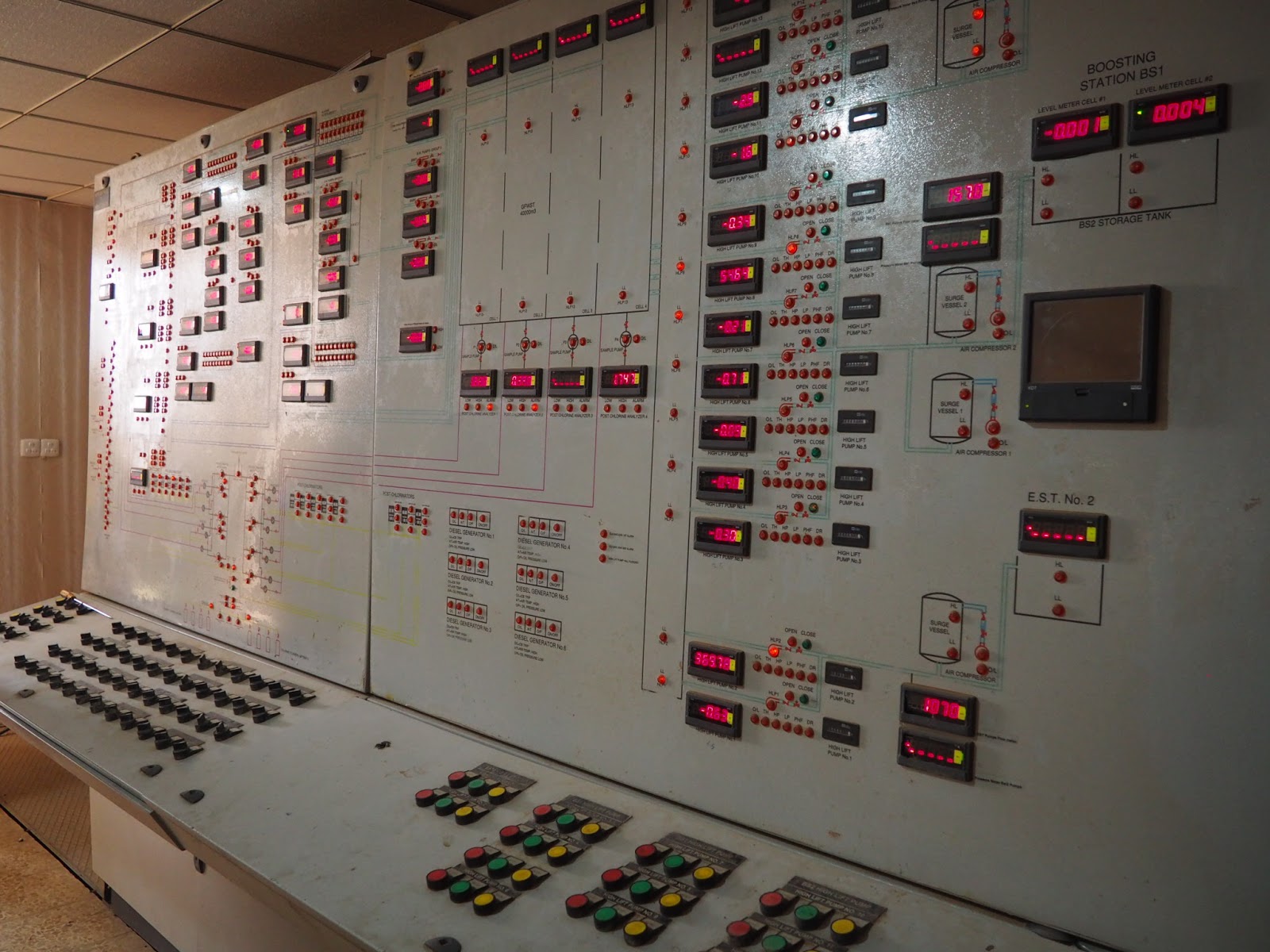 |
| Control panel for the pumps |
 |
| Rapid mixing tanks (first chlorination) |
 |
| Most of the buildings are still damaged |
 |
| Filtration rooms (think massive biosand filters) |
 |
| Gas chlorination |
 |
| Gas chlorination |
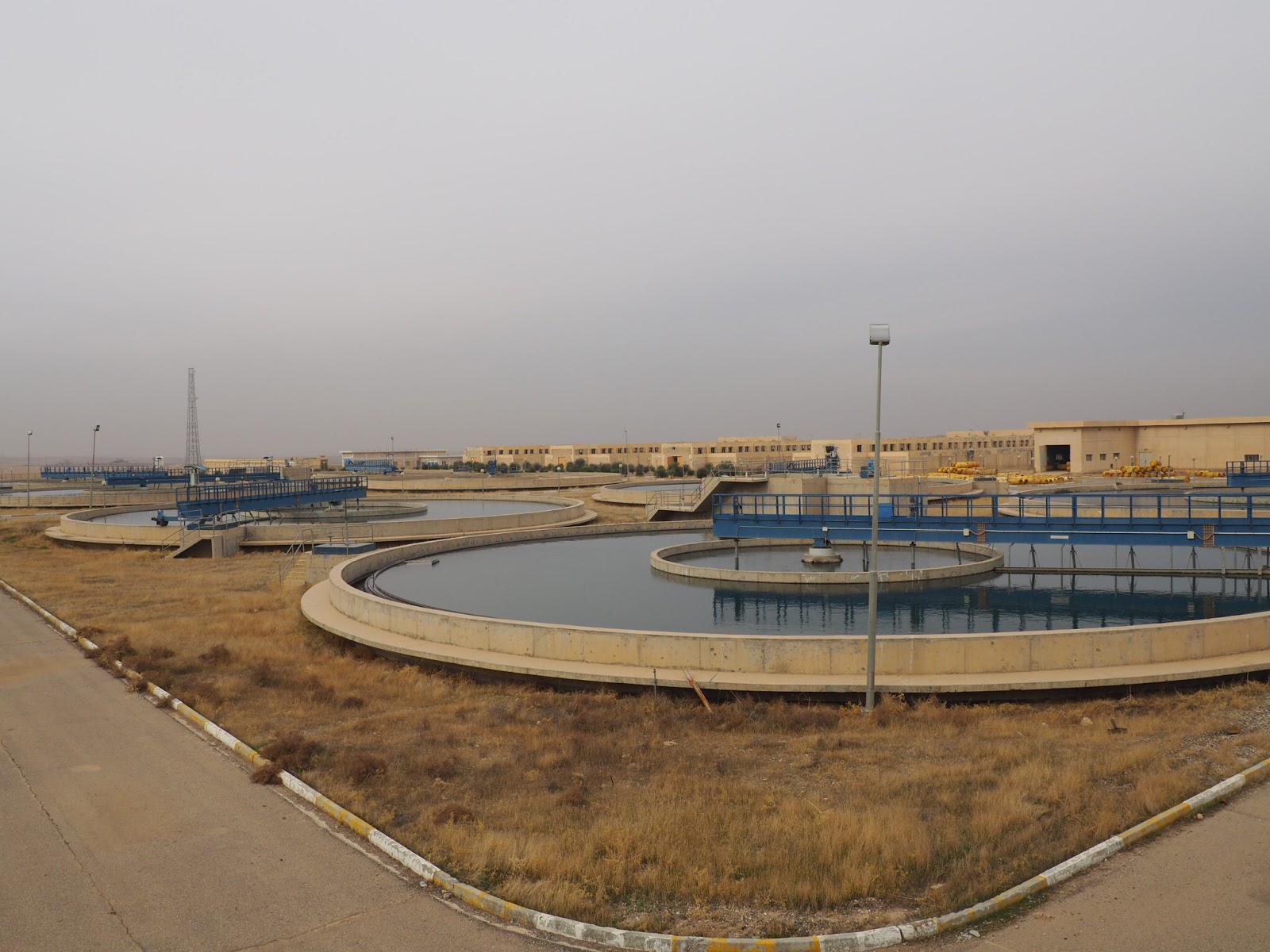 |
| Settlement tanks |
 |
| Settlement tanks |
Subscribe to:
Posts (Atom)